
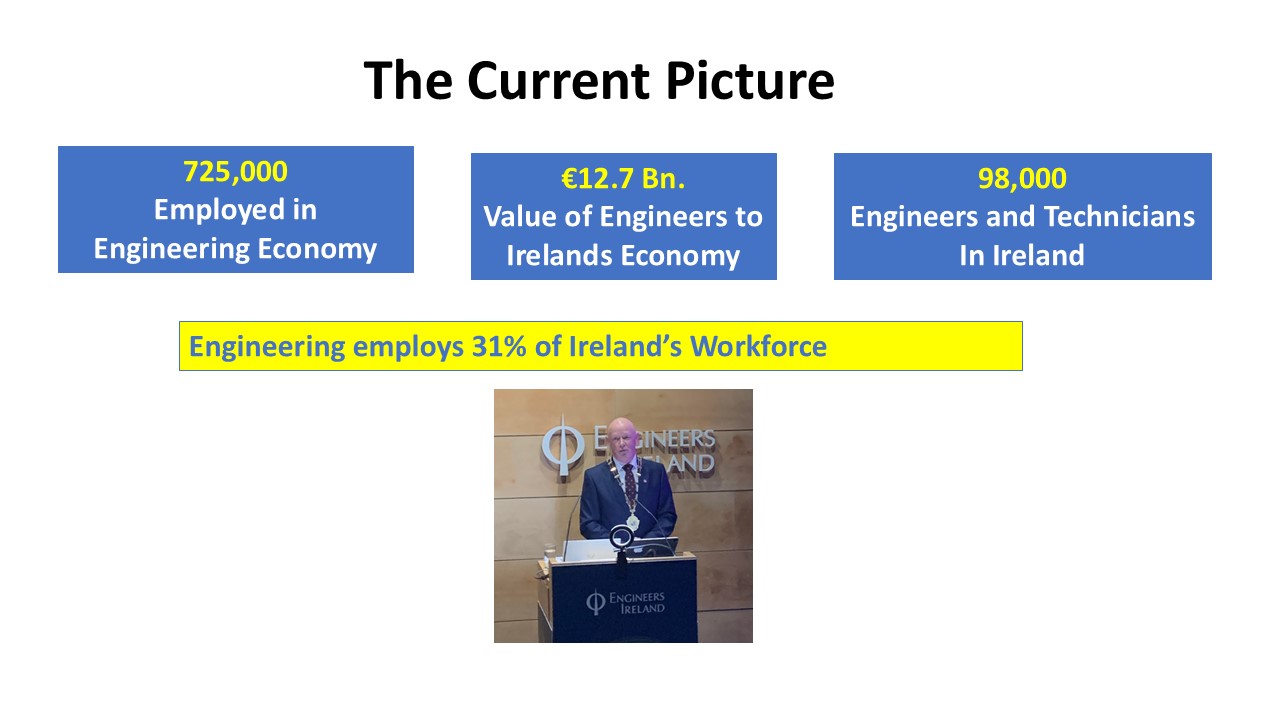
Engineers Ireland President Dave Murphy’s delivered his Presidential Address entitled ‘Who Will Engineer Ireland’s Future? Why Ireland’s Engineering Shortage Matters – and What We Can Do About It on 15th October 2026.
Dave is a Fellow of our Academy and Tom Leahy Academy special advisor and Past President represented the Academy at the event.
This address explored Ireland’s growing shortage of engineering talent, what it means for our future, and how we can inspire, attract, and retain the next generation of engineers.
The research for this centred on two reports published this year:
- “The value of Engineers to the Irish Economy” was published by Engineers Ireland (EI) on 27th August 2026
- The Engineering Economy and Place (EEP) Ireland report was published on 10th March 2026 by The Irish Academy of Engineering (IAE)
Taken together both of these detailed evidence-based reports demonstrate a vibrant engineering economy and the value which Engineers bring to that economy.
The Value of Engineers to the Irish Economy report (EI) – Key findings
- Quarterly surveys of the labour force in both jurisdictions (NI and ROI) are used to update these estimates to the end of 2025. This provides an estimate of 98,041 engineers and engineering technicians on the island, just over 74% of whom live in the Republic.
- It is estimated there were 78,565 engineers and engineering technicians in the Republic in 2022. This is a 34% increase since the 2011 Census, with most of the growth happening since 2016.
- Quarterly surveys of the labour force in both areas are used to update these estimates to the end of 2025. This provides an estimate of 98,041 engineers and engineering technicians on the island, just over 74% of whom live in the Republic.
- Engineers had an average gross salary of €86,154 in 2025, but the median salary is lower at €75,000. Over 80% of engineers saw salary increases over the past year with an average increase of 4.8%. Most have a pension scheme with employers contributing on average 3.5% of gross salary. Total benefits amount to 10% of the basic salary bringing average remuneration to €99,686.
- Tests to compare the results of the survey and the Census indicate that these salary estimates may be used to provide valid estimates for the total economic value that is added by engineers and engineering technicians. The estimate is that value-added by engineers and engineering technicians in the Republic is just over €7 billion per annum – 2.4% of modified gross national income (GNI*) – and just over €2.4 billion – 3.5% of gross domestic product (GDP) – in Northern Ireland. It is also estimated that engineers and engineering technicians pay about €2.25 billion in payroll taxes. Adding an allowance for engineers’ and engineering technicians’ contribution to profits brings the total to €12.65 billion.
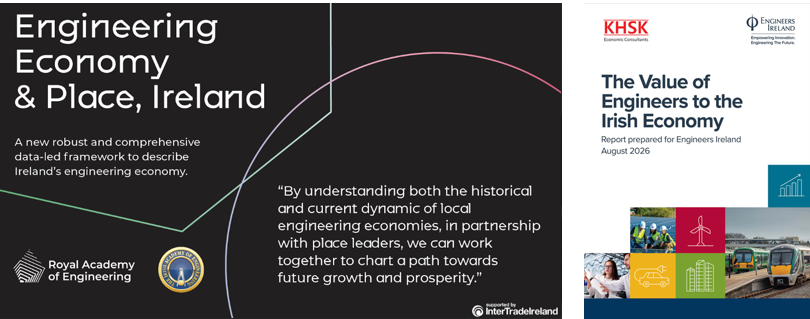
The Engineering Economy & Place(EEP) Ireland report launched on 10th March 2026 by Minister Jack Chambers TD is a landmark report published by the Royal Academy of Engineering and the Irish Academy of Engineering, supported by InterTradeIreland and is one of the outcomes from this joint working by both Academies.
The Engineering Economy & Place(EEP) Ireland report also includes a searchable dashboard
Jack Chambers TD, Minister for Public Expenditure, Infrastructure, Public Service Reform and Digitalisation, said: “The Engineering Economy and Place – Ireland report launched today by the Academies will help decision makers better understand our nation’s engineering strengths and how best to support the sector to meet our shared goals. “
Engineering Economy & Place, Ireland, is the first comprehensive place-based analysis of the engineering economy in the Republic of Ireland. It adapts a methodology used by the Royal Academy of Engineering in the UK and uses datasets including the last available census in 2022. Funded by InterTradeIreland, it is underpinned by analysis from Metro Dynamics.
Engineering Economy & Place(EEP) Ireland report key findings
- For the very first time this EEP Ireland report identifies and quantifies the contribution of Engineering to the Irish Economy.
- The analysis shows that while engineering employment varies across Ireland, engineering is a large part of the employment base everywhere, accounting for 31% of total employment(Over 725,000 people) in 2022.
- Over 725,000 people work in engineering related industries and occupations. This is broken down into 513,000 in engineering occupations and 212,000 who are non-engineering staff (for exampleHR, legal and PR), within engineering firms. Engineering expertise permeates all sectors of Ireland’s economy, with an estimated 40% of those employed in engineering occupations in Ireland, working in companies outside of the engineering sector
- It also demonstrates engineering’s significant role in job creation. From 2011 to 2022, engineering employment grew by 44%, compared to a 29% increase in total employment in Ireland, adding more than 200,000 jobs and increasing engineering’s share of total employment. These are high value jobs, with an average salary of nearly €60,000, 14% higher than the national
- Engineering in Ireland is a highly R&D intensive sector, with over one fifth of those employed in the engineering economy in a role focused on research, develop or evaluate activities-– this is three times more than across the entire economy.
- Coupled with the numbers employed in NI (EEP UK study) almost a million people are employed in the Engineering economy on the island of Ireland
Mapping the engineering economy
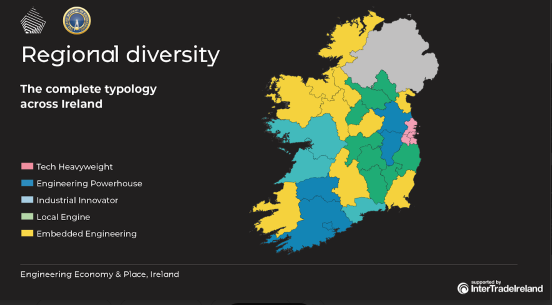
The report found that engineering plays a distinct role and exhibits different features in each of the 31 administrative counties across the country. Using a variety of indicators including volume, value, local significance, industrial specialism and R&D intensity, the counties have been grouped into five categories/typologies:
- Tech Heavyweight
- Engineering Powerhouse
- Industrial Innovator
- Local engine of growth
- Embedded Engineering
The report included 5 case studies covering each of the 5 typologies in detail.
Both reports provide an insight into the size of the Engineering economy, the contribution of engineers and the value of Engineers to the all- island economy.
EI President Dave Murphy concluded his Presidential address by calling on industry partners, including the Irish Academy of Engineering, to increase the number of Engineers with a 10 point action plan and said “If you want to help decide what Ireland looks like in 2050, become an Engineer”