
Engineering Economy and Place (EEP) Ireland report published 10th March 2026.
Tom Leahy FIAE, Special Advisor, Director and past President of the Irish Academy of Engineering, said: “This report arises from a visit by RAE President Sir Jim MacDonald and the then IAE President Tom Leahy to Belfast and Dublin in October 2021 when they both had an audience with President Michael D. Higgins. Arising from this visit a joint Memorandum of Understanding(MoU) was signed by the Presidents of the Royal Academy of Engineering and the Irish Academy of Engineering in May 2022 to work together on shared projects”.
The Engineering Economy & Place(EEP) Ireland report launched on 10th March 2026 by Minister Jack Chambers TD is a landmark report published by the Royal Academy of Engineering and the Irish Academy of Engineering, supported by InterTradeIreland and is one of the outcomes from this joint working by both Academies.

L-R Martin Hogan IAE, Minister Jack Chambers TD, Sean Finlay IAE
The Engineering Economy & Place(EEP) Ireland report also includes a searchable dashboard

L-R Martin Hogan IAE, Tom Leahy IAE, Margaret Hearty ITI, Minister Jack Chambers TD, Ana Avaliani RAE, Sean Finlay IAE, Gillian Gregg RAE.
Jack Chambers TD, Minister for Public Expenditure, Infrastructure, Public Service Reform and Digitalisation, said: “The Engineering Economy and Place – Ireland report launched today by the Academies will help decision makers better understand our nation’s engineering strengths and how best to support the sector to meet our shared goals. “
“My department recently published Ireland’s Accelerating Infrastructure Report and Action Plan. This clearly demonstrates that timely and efficient infrastructure development is essential to meeting the needs of our growing population, supporting economic competitiveness, and delivering the essential public services our people and communities need.
Engineering Economy & Place, Ireland, is the first comprehensive place-based analysis of the engineering economy in the Republic of Ireland. It adapts a methodology used by the Royal Academy of Engineering in the UK and uses datasets including the last available census in 2022. Funded by InterTradeIreland, it is underpinned by analysis from Metro Dynamics.
Report key findings
- For the very first time this EEP Ireland report identifies and quantifies the contribution of Engineering to the Irish Economy.
- The analysis shows that while engineering employment varies across Ireland, engineering is a large part of the employment base everywhere, accounting for 31% of total employment in 2022.
- Over 725,000 people work in engineering related industries and occupations. This is broken down into 513,000 in engineering occupations and 212,000 who are non-engineering staff (for exampleHR, legal and PR), within engineering firms. Engineering expertise permeates all sectors of Ireland’s economy, with an estimated 40% of those employed in engineering occupations in Ireland, working in companies outside of the engineering sector
- It also demonstrates engineering’s significant role in job creation. From 2011 to 2022, engineering employment grew by 44%, compared to a 29% increase in total employment in Ireland, adding more than 200,000 jobs and increasing engineering’s share of total employment. These are high value jobs, with an average salary of nearly €60,000, 14% higher than the national
- Engineering in Ireland is a highly R&D intensive sector, with over one fifth of those employed in the engineering economy in a role focused on research, develop or evaluate activities-– this is three times more than across the entire economy.
Mapping the engineering economy
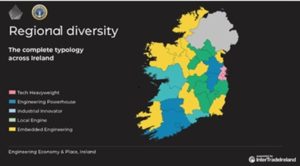
The report found that engineering plays a distinct role and exhibits different features in each of the 31 administrative counties across the country. Using a variety of indicators including volume, value, local significance, industrial specialism and R&D intensity, the counties have been grouped into five categories/typologies:
- Tech Heavyweight
- Engineering Powerhouse
- Industrial Innovator
- Local engine of growth
- Embedded Engineering
The report included 5 case studies covering each of the 5 typologies in detail.
Minister for Public Expenditure, Infrastructure, Public Service Reform and Digitalisation, Jack Chambers, shared the importance of the report in “better understanding our nation’s engineering strengths and how best to support the sector to meet our shared goals.”

Sean Finlay FIAE, President of the Irish Academy of Engineering, said: “There has long been a consensus in Ireland that engineering is integral to its economy. Developing and deploying the Engineering Economy and Place approach has allowed us to not only demonstrate that engineering plays a far greater role in Ireland’s economy than captured by more traditional analyses; but also takes a much more granular view of the role of engineering in the place-specific contexts of the 31 administrative counties.”
Margaret Hearty, CEO of InterTradeIreland, said: “InterTradeIreland welcomes the findings from the Engineering Economy and Place report, which provides a clear, data-driven picture of how engineering and engineering-intensive activities are distributed across the island and its sectors, and how significant these activities are to local economies.
“The report demonstrates the scale and diversity of the engineering economy in Ireland, with almost a third of jobs relating to the engineering sector.
“Through our Synergy programme, we are proud to have supported the Royal Academy of Engineering and the Irish Academy of Engineering to collaborate and deliver this first-of-a-kind report and full map of the engineering economy at country and all island level, which will strengthen the evidence base for investment and policy targeting.”

Academy news bulletin 10th March 2026-Launch of the EEP Ireland report final