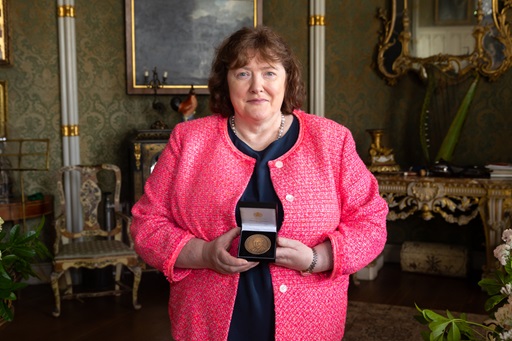
The Irish Academy of Engineering (IAE) is delighted to announce Dr. Ann B. Kelleher is the recipient of the 2024 Parsons Medal awarded for excellence in engineering, the only annual medal given by the IAE.
Fittingly the Award was held during the Birr Engineering Heritage Festival at Birr Castle Demesne, ancestral home of Sir Charles Parsons, eminent Irish engineer, and namesake of this medal, who won it for his invention of the compound steam turbine.
The recipient of this year’s Parsons Medal is Dr. Ann B. Kelleher from Intel Corporation. The medal was presented to Dr. Kelleher by the Academy President and Executive and Sir Parsons’ descendant, the Earl of Rosse, Sir Brendan Parsons.
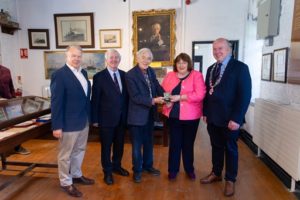
Sean Finlay, Tom Leahy, Sir Brendan Parsons, Ann B. Kelleher and Seamus McKeague Academy President.
Dr. Kelleher is an Executive Vice President at Intel Corporation, where she leads Foundry Technology Development. Advancing semiconductor technology, a process known in the industry as Moore’s Law, is the core competency of Dr. Kelleher’s group at Intel Foundry. Under Ann’s leadership, her team has introduced multiple world’s first technologies to power our increasingly digital society. In the United States, Ann also serves on the Global Semiconductor Alliance (GSA) Board of Directors, and the Industry Advisory Council for NSTC as part of the CHIPS and Science Act.
The citation was presented to Ann by Sir Parsons’ descendant, the Earl of Rosse, Sir Brendan Parsons and his daughter Lady Alicia Clements and the Academy Executive. Alicia is an aeronautical Engineer and manages the estate and gave us a tour of the visitor centre before the award ceremony.
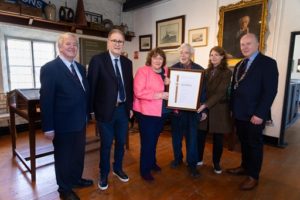
Tom Leahy, Joe Harford, Ann B. Kelleher, Sir Brendan Parsons, his daughter Alicia and Seamus McKeague Academy President.
Speaking about why Dr. Kelleher was chosen to be the recipient of the Parsons Medal, Seamus McKeague, President of the IAE said: “The Parsons Medal recognises engineers who have made exceptional contributions to the advancement of the application of engineering, science and technology that result in significant social and/or economic impact. Dr. Kelleher is this year’s recipient for her strategic leadership in the global semiconductor industry.”
In response to receiving the Parsons Medal, Dr. Kelleher said: “I am honored to receive the prestigious Parsons Medal and would like to thank the IAE for selecting me from many worthy candidates. The field of engineering has inspired me from my days as a student and semiconductor researcher in Ireland to my career at Intel. I hope that my journey can inspire others to embrace a career in engineering, both for the individual satisfaction of working on interesting problems as well as the chance to make an impact on one’s community both locally and globally.”
Before leading Foundry TD, Dr. Kelleher oversaw worldwide manufacturing operations for Intel, including Intel’s facilities in Leixlip, currently the largest and most advanced semiconductor production site in Europe.
A plaque commemorating all the Parsons medals awarded now hangs in the Birr castle visitor centre.
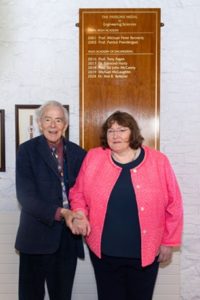
Sir Brendan Parsons and Ann B. Kelleher with the recipients of the Parsons medals.
Ann celebrated the event with family and friends.
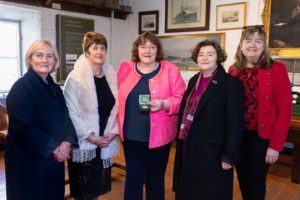
Ann was congratulated by Fellows of the Academy who attended the award ceremony.
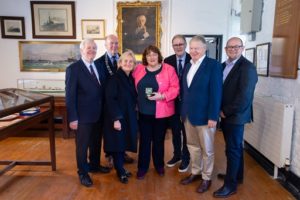
Tom Leahy, Seamus McKeague, AnnMarie Holmes, Ann B. Kelleher, Joe Harford, Sean Finlay, William Scanlon.
About the Irish Academy of Engineering
The Irish Academy of Engineering (IAE) is dedicated to advancing the wellbeing of the island of Ireland by marshalling the expertise and insights of eminent engineers to provide in dependent advice to policy makers on matters involving engineering and technology. Our membership is made up of eminent engineers, all leaders in their fields, based both in Ireland and abroad. The IAE regularly publishes research and guidance on matters relating to engineering, technology, and the development of Ireland. The Irish Academy is a member of the European Council of Academies of Applied Sciences, Technologies and Engineering (Euro-CASE) which is an independent non-profit organisation of national academies of Engineering, Applied Sciences and Technologies from 23 European countries. and the International Council of Academies of Engineering and Technological Sciences (CAETS) with member Academies from 33 Countries. Visit our website www.iae.ie for more information.
After the award ceremony Ann, her family and friends and members of the Academy were invited to lunch in Birr Castle hosted by Sir Parsons’ descendant, the Earl of Rosse, Sir Brendan Parsons.
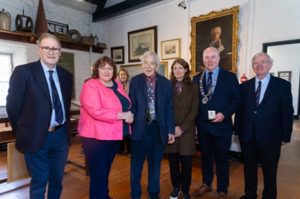
Joe Harford, Ann B. Kelleher, Lady Rosse, Sir Brendan Parsons, Lady Alicia Clements, Seamus McKeague, Tom Leahy.
About Birr Castle Demesne and Sir Charles Parsons
The Award-Winning Gardens of Birr Castle Demesne and Science Centre in Ireland are both rich in amazing feats of science and engineering as well as rare trees and flowers, wonderful wildlife, and walks along peaceful rivers and the lake. Created over generations it is an environmental and scientific time capsule. The Science Centre at Birr brings to life the scientific history of the Castle and the story of the Parsons family who lived there since 1620.
Sir Charles Parsons (1854-1931) was the youngest son of the famous astronomer Williams Parsons, 3rd Earl of Rosse, whose home was at the Birr Castle Demesne, Co Offlay. Sir Charles Parsons was home tutored by leading astronomers of the day and following his academic years in Trinity College Dublin and St John’s College, Cambridge, Charles completed his training as an engineer at Armstrong ship-builders in Newcastle-Upon-Tyne. Charles is best known for his development of the compound steam turbine and its application to power generation and shipping propulsion. He built a sizeable and successful engineering company at the Heaton works in Newcastle-Upon-Tyne. He had a great influence on the naval and electrical engineering fields in the years leading up to WWI and beyond. Charles Parsons is recognised as one of the world’s greatest engineers, an entrepreneur and inventor, whose ability to build the team to succeed in a highly competitive landscape, and through the Great War, to deliver electricity to all.