

ACADEMY NEWS – IAE/RAE MoU update – 14th August 2024 – Engineering Economy and Place (EEP) Ireland project
In October 2021 the President of the Royal Academy of Engineering(RAE) Sir Jim McDonald visited Belfast and Dublin. During the visit to Belfast Irish Academy of Engineering President Tom Leahy met with the RAE President and while travelling by train to Dublin, discussed the outlines of an enduring legacy from the visit. The Highlight of the Dublin visit was an audience with President of Ireland Michael D. Higgins to meet both IAE and RAE Presidents.

During 2022, the Royal Academy of Engineering (RAE) and Irish Academy of Engineering (IAE) developed a Memorandum of Understanding( MoU) that sets out a shared ambition that by working together both Academies can help stimulate collaboration not just north and south but also east and west, to maximise the contribution that engineering can make to economic growth and improve outcomes for everyone across the UK and Ireland.
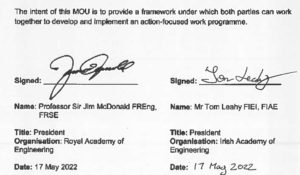
The MoU was signed by both Presidents in May 2022.
A steering group formed of Fellows of both Academies identified and agreed a programme of work to support this ambition. The first phase of activity, supported with funding from RAE International Science Partnership Funding and the InterTradeIreland (ITI) Synergy Programme, was launched by Academy Presidents in Belfast in October 2023.
The Engineering Economy and Place (EEP), Ireland project is a core element of the first phase of activity and is being project managed from the RAE Enterprise Hub in Belfast by Gillian Gregg RAE Head of Regional Engagement and Kathryn McKenna RAE Senior Enterprise Manager (Ireland) working with IAE Special Advisor & Immediate Past President Tom Leahy.

The Project
Earlier this year (February 2024), RAE commissioned Metro Dynamics to undertake an assessment of available data in Ireland, aiming to replicate the methodology developed in the UK Engineering Economy and Place study.
Building on the outcome of the current data exploration phase, the project has the potential to progress to a second phase of analysis and reporting, and to draw out (for the first time) comprehensive analysis of the engineering economy at the local and whole island level. As such, outputs have the potential to inform local decision making, highlighting the role and relative strengths and challenges of the local engineering sector at the county level.
Content overview
The approach to measuring the engineering economy is based on a 2018 study undertaken by Engineering UK, the Engineering Council and the Royal Academy of Engineering. This work developed a binary definition of engineering based on both industry and occupations, described as the ‘Engineering Footprint.’
By combining data on occupations and on sectors we can measure the full footprint, covering both engineering businesses and engineers employed in industries which are not part of the engineering definition.
Timeline
A workshop is taking place in August 2024 with a view to completing a draft with a planned publication in 2025.
This project is a good example of both Academies of Engineering working together and delivering on their mission statements of providing thought leadership in a time of great change and harnessing the power of engineering and technology to build a sustainable society and an inclusive economy that works for everyone.